
China Begins Construction of World’s Largest Single-Unit Floating Offshore Wind Turbine

On May 20, SPIC Guangdong Company held a groundbreaking ceremony in Zhuhai for the construction of the “Tuqiang” (in Chinese, it means “For Strength”) 20 MW floating offshore wind demonstration turbine, marking the official start of construction for the world’s first 20 MW-class deep-sea floating wind turbine foundation designed with a steel-concrete hybrid structure. Carrying the mission of transforming China’s national key R&D achievements into real-world engineering applications, the “Tuqiang” project represents a major milestone in China’s deep-water floating offshore wind technology development.
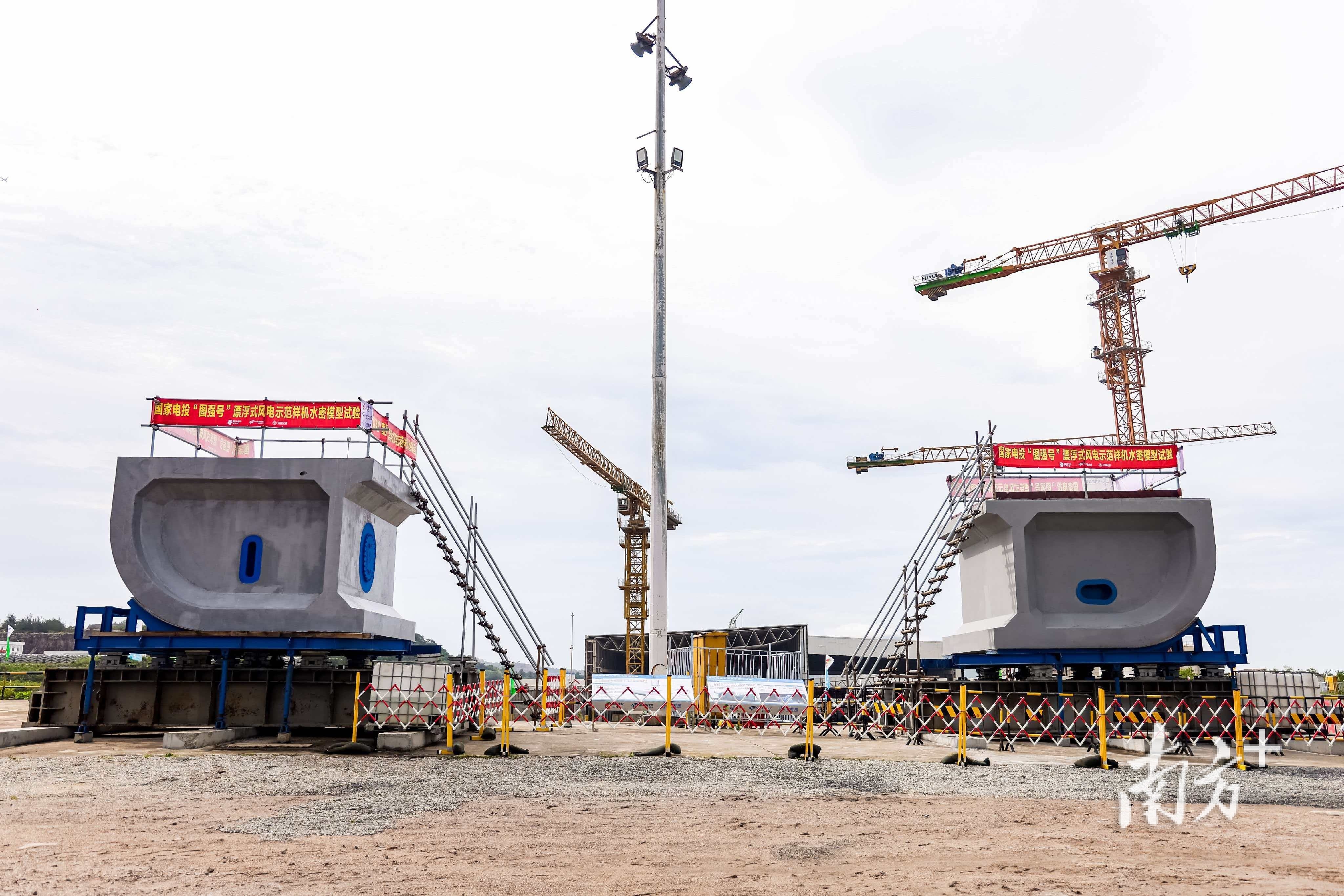
Photo: the test platform for Deep-Sea Floating Offshore Wind Turbine Foundations, Source: Foshan Plus
The “Tuqiang” project serves as the core demonstration platform of China’s national key research program titled “Key Technologies and Applications for Ultra-Large Deep-Sea Floating Offshore Wind Turbine Foundations.” Led by SPIC Guangdong Company, the project brings together leading Chinese research institutions and enterprises in the offshore wind sector, including Zhejiang University, Goldwind, CCCC Fourth Harbor Engineering Co., Ltd., and Guangzhou Salvage Bureau, forming a collaborative industry-academia-research consortium. The project focuses on developing high-load-capacity, low-cost, and highly reliable floating wind foundation technologies capable of withstanding China’s deep-sea typhoon conditions and complex geological environments.
The floating platform will be constructed at the Niutoudao precast facility in Zhuhai operated by CCCC Fourth Harbor Engineering. Upon completion, it will be installed at SPIC’s Yangjiang Sanshandao III offshore wind farm for full-scale offshore testing, including operations under typhoon conditions, helping accelerate the commercialization of China’s floating offshore wind technologies. The project underwent more than two years of R&D and multiple rounds of design optimization, with several core technologies being applied in the industry for the first time.
“Tuqiang” is currently the world’s largest floating offshore wind demonstration project in terms of single-unit turbine capacity. The 20 MW floating wind turbine is expected to generate approximately 55 million kWh of electricity annually, enough to supply power to around 16,000 households.
The project introduces an innovative steel-concrete hybrid floating structure. Its steel-concrete connection sections adopt embedded-node technology combined with prestressed tendons to form a stable integrated structure, significantly increasing the proportion of reinforced concrete used in the foundation while reducing steel consumption and lowering construction costs.
The project will also pioneer China’s first “static-to-dynamic” offshore installation method. Supported by independently developed wave-compensation installation technology, the approach addresses the challenge of offshore installation for floating wind turbines, simplifies conventional construction procedures, reduces operational risks, and provides valuable experience for future maintenance and operations across the industry.
Thanks to these technological innovations, the steel consumption per megawatt for the “Tuqiang” foundation is expected to fall below 300 tons, while the cost per kilowatt is projected to drop below RMB 20,000 (US$2,900 per kw)— more than 30% lower than existing floating wind demonstration units currently in operation. The project is expected to play a significant role in advancing China’s floating offshore wind sector from prototype demonstration toward large-scale commercial deployment.
The demonstration site presents harsh ocean conditions. Sea current velocity reaches 2.3 meters per second, while the once-in-50-year maximum wave height can reach 23 meters and peak wind speeds exceed 77 meters per second — conditions considered extremely rare among global floating offshore wind projects. Extensive scaled-model testing was conducted during the project’s early stages, fully validating the safety and reliability of the “Tuqiang” design.
As of now, State Power Investment Corporation has accumulated 6.32 GW of installed offshore wind capacity, including 1.8 GW already operational in Guangdong Province. The company is accelerating offshore wind projects in Yangjiang and Jieyang, providing strong support for offshore wind innovation and integrated marine economic development.
SPIC Guangdong Company is also actively exploring integrated “offshore wind +” development pathways. In Jieyang, Guangdong, the company has completed the “Dragon Palace” marine ranch project and is advancing a megawatt-scale offshore seawater hydrogen production demonstration project.
It would appear that we are going to continue wanting to blast off into space. Each time we do that we are dumping an incredible amount of carbon dioxide and water vapor into the atmosphere. Try reading my article titled: the Magnificent erocket.
I'm trying to save Civilization by drawing attention to an extraordinary moment that's trying to happen. The monks Theory of Everything is explaining mystery after mystery after mystery while our scientists are saying crazy things and admitting that they can't make sense of any of the crazy things they are saying and now cannot understand 95% of the universe.
We need to quickly start solving our problems which this allows us to do otherwise we will resort to violence to solve our problems. I was hoping that you would help me avoid that by letting me somehow talk to your audience or maybe write an article with you to your audience about this exciting moment and get some attention that it deserves?